


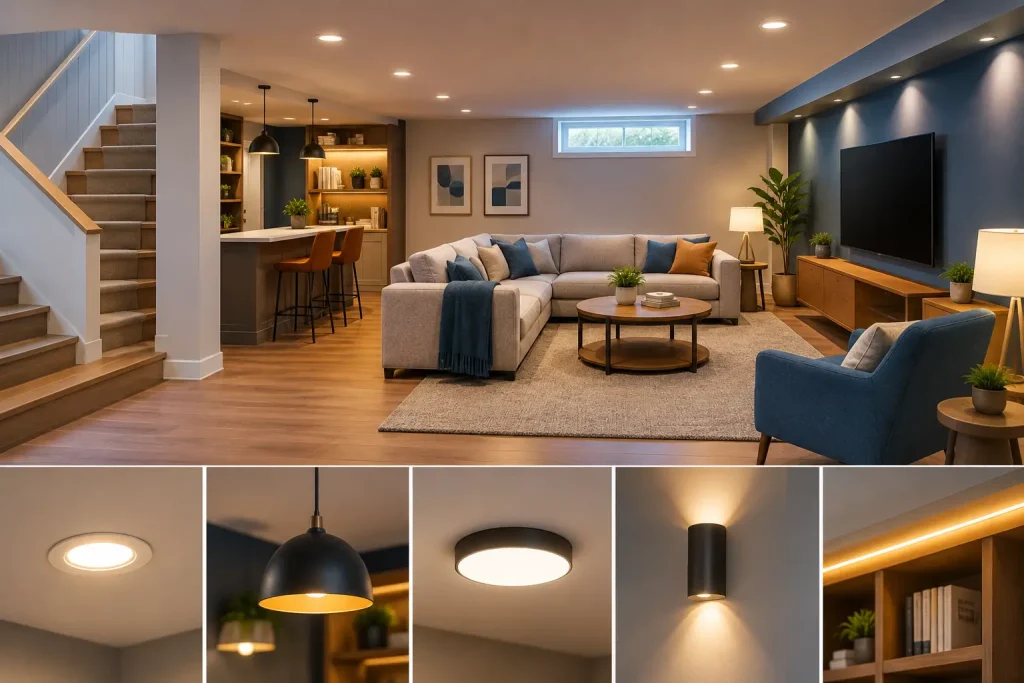
A basement can have beautiful flooring, fresh paint, and custom built-ins, then still feel unfinished because the lighting is wrong. The best basement lighting options do more than make a room brighter. They make a low-ceiling space feel more open, help define how each area will be used, and prevent the dark corners that make a finished basement feel like an afterthought.
For most homeowners, one fixture in the center of the ceiling is not enough. A well-planned basement needs layers of light that work together: broad ambient light for the whole room, focused task light where people read or work, and accent lighting that gives the space warmth and character. The right combination depends on ceiling height, room layout, natural light, and whether the basement will serve as a family room, office, gym, guest suite, playroom, or entertainment area.
Start With the Basement You Actually Have
Lighting should be planned before drywall goes up, not selected at the end because a room feels dim. In Staten Island homes, basements often have ductwork, steel beams, plumbing lines, utility panels, and lower ceilings that affect fixture placement. A contractor should coordinate lighting with framing, insulation, HVAC, and electrical work so the finished ceiling looks intentional instead of crowded with last-minute cuts.
First, look at the ceiling condition. A basement with a clean, framed drywall ceiling can accommodate recessed lights, surface-mounted fixtures, or decorative pendants. A lower ceiling may call for slim recessed fixtures or low-profile flush mounts. If you need access to mechanical systems, a drop ceiling can still look polished when paired with modern flat LED panels or recessed-style grid fixtures.
Natural light matters too. A basement with walkout doors or full-size windows needs a different plan than a below-grade space with only small hopper windows. Daylight can reduce the need for strong lighting during the day, but it should not dictate the entire design. The room still needs even, comfortable illumination at night.
Best Basement Lighting Options for Everyday Use
Recessed LED lights for clean, even coverage
Recessed LED lights are often the strongest foundation for a finished basement. They sit within the ceiling, preserve headroom, and spread light across the room without hanging down into the space. Slim LED wafer lights are especially useful where joist cavities are shallow or where ductwork limits installation depth.
For a main recreation room or open family area, recessed lights can be laid out in an even pattern that avoids shadows along walls and in seating areas. They work well with dimmers, which is a major advantage. Bright light is useful for cleaning, kids’ activities, or game night, while a lower setting makes the same room more comfortable for watching a movie.
The trade-off is that recessed lighting needs thoughtful spacing. Too few fixtures create dark patches. Too many can make the ceiling look spotted and the room feel harsh. Placement should also account for beams, soffits, built-ins, and television walls before electrical rough-in begins.
Low-profile surface fixtures for lower ceilings
Not every basement ceiling is a good candidate for recessed lighting. Where framing, piping, or concrete conditions make recessed installation impractical, low-profile surface-mounted LED fixtures are a dependable choice. These fixtures sit close to the ceiling and can provide generous ambient light without the bulk of older flush-mount fixtures.
They are particularly useful in utility-adjacent areas, laundry spaces, hallways, and finished basements with very limited ceiling height. A quality fixture with a frosted lens creates softer, more even light than a single exposed bulb. Choose a design that matches the rest of the home’s finish level so it reads as part of the renovation, not a shortcut.
Track lighting where flexibility matters
Track lighting is a practical option for basement areas that serve more than one purpose. Adjustable heads can be directed toward artwork, a bar, a game table, shelving, or a reading chair. It is a good fit for an exposed ceiling design as well, where recessed fixtures may not make sense.
Modern track systems are cleaner and less bulky than the versions many homeowners remember from years ago. Still, track lighting is usually best as a supporting feature rather than the only source of light in a large room. Aimable heads are useful, but they can create glare and uneven brightness if they are not planned carefully.
Wall sconces for warmth and safer circulation
Wall sconces bring light down from the ceiling and help a basement feel more like a finished living area. They work especially well in stairways, hallways, media rooms, and along a long wall where a ceiling fixture alone would leave the space flat.
In a home theater or TV area, dimmable sconces provide enough light to move around safely without washing out the screen. In a basement stairwell, they can improve visibility and add a finished architectural detail. Sconces require wall wiring and proper placement, so they are easiest to include during a full remodel.
Under-cabinet and toe-kick lighting for bars and built-ins
A basement bar, kitchenette, entertainment wall, or custom storage unit benefits from integrated lighting. Under-cabinet LED strips brighten a countertop for serving food or mixing drinks. Toe-kick lighting under base cabinets adds a subtle glow that makes a bar area feel finished without relying on overhead lights alone.
This is accent lighting, but it has a practical side. It gives guests enough light to move through the area and helps separate the bar or kitchenette from the rest of an open basement. Warm, dimmable LEDs usually create the most inviting result.
Floor and table lamps for flexible comfort
Hardwired lighting should handle the main job, but lamps make a basement more livable. A floor lamp next to a sectional, or a table lamp on a side table, adds soft light at eye level. This is often the difference between a room that is merely bright and a room where people want to spend time.
Lamps are also an easy way to adjust after the renovation is complete. If a reading corner feels dark, a properly placed lamp solves the issue without opening walls. Use switched outlets where possible so lamps can be controlled from the room entrance.
Choose the Right Color Temperature
Color temperature changes how every finish in the basement looks. It is measured in Kelvins, and choosing the wrong range can make a well-built room feel cold or yellow.
For most finished basements, 2700K to 3000K is the right starting point. This warm-white range works well with wood flooring, painted walls, upholstered furniture, and family-room settings. It feels comfortable without being overly amber.
A home office, workout room, laundry area, or workshop may benefit from 3500K to 4000K lighting, which looks crisper and supports detail-oriented tasks. Use cooler light carefully in living spaces. Bright blue-white light can make a basement feel more like a commercial space than part of the home.
Color rendering is worth considering as well. LED fixtures with a high color rendering index, ideally 90 CRI or better in visible living areas, show paint colors, wood tones, and skin tones more accurately. That matters when you have invested in tile, custom millwork, or a detailed finish package.
Plan Lighting by Zone, Not by Square Footage Alone
An open basement should not be lit as one large box. Divide it by how the family will use it. A seating area needs ambient lighting and a few softer sources near furniture. A bar needs task lighting at the counter. A gym needs brighter, more even coverage. A playroom needs illumination that reaches storage, tables, and corners where children actually spend time.
The same thinking applies to a basement with separate rooms. A guest bedroom should have ceiling light, bedside light, and a switch arrangement that is easy for visitors to use. A bathroom needs bright vanity lighting that reduces facial shadows, plus a properly rated fixture for damp locations. Storage rooms and mechanical areas should be bright enough for safe access and service work, even if they are not designed like finished living spaces.
Do Not Skip Dimmers, Switches, and Electrical Planning
The fixture itself is only part of the job. Good switch placement makes the lighting convenient from day one. At minimum, the main basement entrance should control general lighting, and stair lights should be operable from both the top and bottom of the stairs. Separate controls for entertainment areas, bar lighting, and accent lighting give the room far more flexibility.
Dimmers are one of the best upgrades in a basement renovation. They allow one room to shift from bright and active to relaxed and comfortable without changing fixtures. Make sure the dimmer is compatible with the chosen LED fixture. Not every LED and dimmer combination performs well together, and mismatched products can cause flickering or limited dimming range.
Electrical work should be planned with licensed professionals and completed to applicable code. This is especially important in basements, where moisture concerns, bathroom fixtures, utility equipment, and finished-wall access all need to be addressed correctly.
Make the Light Work With the Finish Work
Lighting has to support the details around it. Recessed fixtures should line up with room geometry, not land awkwardly beside a beam or in the center of a soffit. Sconces should be centered with wall panels, built-ins, or furniture layouts. Cabinet lighting needs hidden wiring paths so the finished work stays clean.
That coordination is where a full-service remodeling approach pays off. When framing, electrical, drywall, paint, flooring, and finish carpentry are considered together, the basement looks planned from every angle. Clean Sweep Contracting approaches basement renovations with that full picture in mind, because a polished result is built long before the final fixture is switched on.
Before choosing a fixture style, stand in the basement and picture the room at 8 p.m. Think about where people will sit, walk, work, watch TV, and gather. The best lighting plan is the one that makes those everyday moments feel easy, comfortable, and fully at home.