


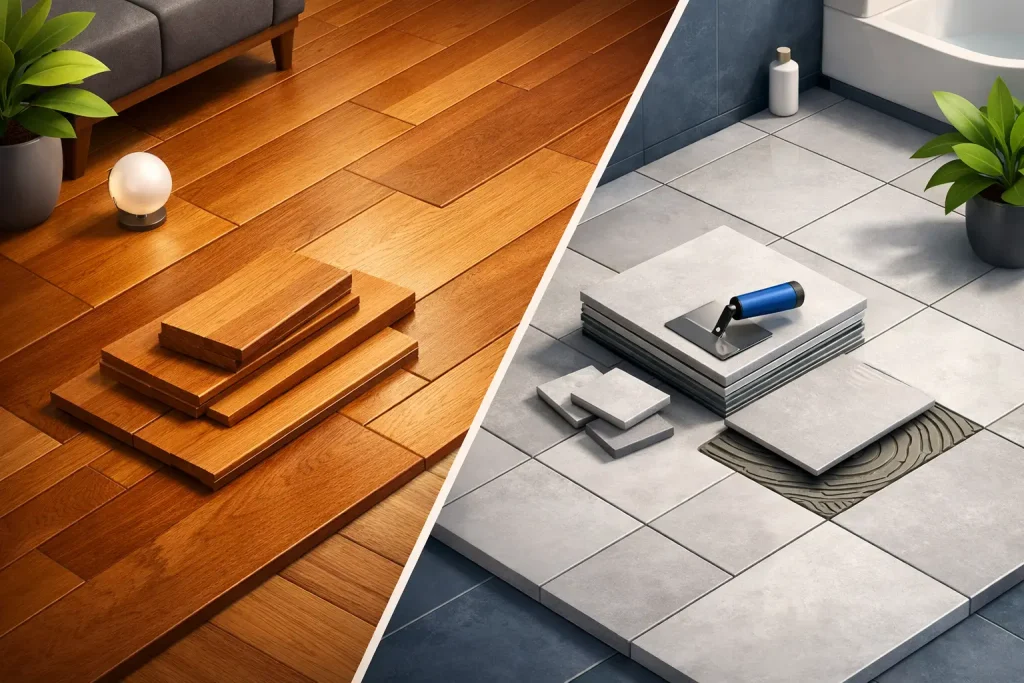
The wrong floor shows itself fast. You feel it on cold mornings, notice it after a spill, and regret it when wear starts showing in the busiest part of the house. When homeowners compare hardwood flooring vs tile, they are usually not choosing between two bad options. They are choosing between two strong materials that perform very differently once real life starts happening.
That is where the decision gets more practical than decorative. A floor has to look right, hold up to daily traffic, fit the room, and make sense for the way your household lives. If you are remodeling a kitchen, bathroom, basement, or main living area, the better choice depends on more than the sample board.
Hardwood flooring vs tile: what really separates them
At a glance, hardwood usually wins on warmth and comfort. Tile usually wins on water resistance and durability. That is the simple version, but it leaves out the details that matter once the job is installed.
Hardwood brings a natural look that many homeowners still prefer for living rooms, bedrooms, hallways, and open-concept spaces. It feels softer underfoot, adds visual warmth, and can help a home feel more finished and inviting. If you want a classic material that ages with character, hardwood has real appeal.
Tile is a tougher worker in wet or messy spaces. It handles water far better, stands up well to pets and heavy traffic, and gives you more design flexibility in terms of pattern, color, and finish. In bathrooms, mudrooms, and many kitchens, that matters more than the softer feel of wood.
The real question is not which one is better overall. It is which one is better for that room, that household, and that budget.
Best rooms for hardwood flooring vs tile
Room use should lead the decision. A great-looking floor that does not fit the space becomes a problem you paid for.
Where hardwood makes more sense
Hardwood is often the stronger choice in bedrooms, dining rooms, family rooms, and formal living areas. These spaces benefit from the warmth and continuity wood provides, especially when homeowners want one consistent floor running through much of the home. That continuity can make rooms feel larger and more connected.
Hardwood is also a smart fit in upstairs areas where standing water is less of a daily concern. For families who care about comfort and a quieter walking surface, wood has an advantage. It does not have the hard, cold feel that tile can bring, especially in winter.
That said, hardwood does need protection. If a household has large dogs, constant tracked-in moisture, or frequent spills that sit too long, wear can show faster.
Where tile usually wins
Tile is built for rooms that take a beating. Bathrooms are the clearest example. Kitchens can go either way, but tile has a strong case if cooking is heavy, cleanup is frequent, or water around sinks and appliances is a concern. Basements, laundry rooms, entryways, and mudrooms also lean toward tile for practical reasons.
In homes near the water or in areas where wet shoes, snow, and rain get tracked inside, tile can be the lower-stress option. It is easier to mop, less vulnerable to moisture damage, and generally more forgiving when life gets messy.
For homeowners in Staten Island who deal with changing seasons, wet entry points, and busy family traffic, this can be a big factor. A floor should match the pace of the home, not fight it.
Cost, maintenance, and long-term value
Price matters, but so does what you get for that price over time.
Hardwood can cost more depending on species, plank width, and installation conditions. Solid hardwood and higher-end engineered wood are not cheap materials, and quality installation matters. The upside is that real wood can add perceived value and, in many cases, can be refinished rather than fully replaced when surface wear shows up.
Tile ranges widely in price. Basic ceramic can be budget-friendly, while porcelain, large-format tile, and custom patterns can climb fast. Labor can also be significant, especially when the subfloor needs prep, leveling, or waterproofing. Still, once tile is installed correctly, it tends to hold up for a very long time with less routine worry.
Maintenance is where the difference becomes obvious. Hardwood needs more care. You want to clean it with the right products, avoid standing water, and stay on top of scratches and finish wear. Tile is easier to live with day to day, though grout lines may need periodic cleaning and sealing depending on the material.
If you are thinking long term, hardwood often brings a classic resale appeal. Tile brings practical durability. Neither is automatically the better investment. The value comes from choosing the right one for the space.
Comfort, appearance, and daily living
This part gets personal fast because it is about how your home feels, not just how it performs.
Hardwood has a natural warmth that tile does not fully replicate. It is easier on the feet, usually quieter, and often creates a higher-end look across open living spaces. If your goal is a welcoming, finished interior with timeless character, hardwood is hard to beat.
Tile offers a cleaner, sharper, more versatile visual range. You can go traditional, modern, rustic, or highly customized. Wood-look tile has also become popular for homeowners who want the appearance of wood with better water resistance. It is a useful middle ground, though it still feels like tile underfoot.
Temperature is another factor. Tile can feel cold, which some homeowners like in hotter months and others dislike all year. Hardwood tends to feel more comfortable naturally. If radiant heat is part of the plan, tile works especially well with that system.
Household noise matters too. Tile is harder and more echo-prone, especially in open rooms. Hardwood is not silent, but it generally has a softer sound profile than tile.
Durability depends on what you mean by durable
Both materials are durable, just in different ways.
Tile resists scratches, dents, and water better than hardwood. That makes it ideal for high-abuse areas. But tile can crack if something heavy hits it hard enough, and repairs can be tricky if matching material is no longer available.
Hardwood is more vulnerable on the surface. It can scratch, dent, and react to moisture. But unlike many tile installations, wood can often be sanded and refinished, giving it a second life without tearing the whole floor out.
So when people ask which lasts longer, the honest answer is that it depends on what the floor has to survive. A busy kitchen with spills and dropped utensils is one thing. A low-moisture living room is another.
Installation quality matters as much as material
A bad install can ruin a good product. This is especially true when homeowners are comparing hardwood flooring vs tile based only on product samples or pricing.
With hardwood, subfloor condition, moisture levels, acclimation, and layout all matter. If those basics are skipped, you can end up with movement, gaps, squeaks, or premature wear. With tile, the prep work is just as critical. Uneven surfaces, poor underlayment, bad spacing, or weak waterproofing can cause cracking and failure over time.
That is why the floor decision should not be separated from the contractor decision. A properly installed floor looks better, lasts longer, and saves money by avoiding preventable repairs.
So which one should you choose?
Choose hardwood if you want warmth, continuity, and a classic finish in dry living spaces where comfort matters as much as durability. Choose tile if moisture, mess, and heavy wear are part of the room’s daily routine and you want the lowest-stress maintenance option.
If the house is being remodeled in phases, mixed materials can make the most sense. Hardwood in the main living areas and bedrooms, tile in bathrooms, laundry areas, entryways, and certain kitchens is a common combination for a reason. It gives each room the floor that matches its job.
The best choice is usually not the trendiest one. It is the one that fits how your home actually gets used, how much maintenance you want to deal with, and how long you expect the result to last.
A floor is not just a finish selection. It is something your family lives on every day. Pick the one that will still make sense long after the samples are put away.