


If your kitchen still looks like a 2000s showroom with dark granite, bulky soffits, and not enough usable storage, you are not alone. A lot of homeowners looking at kitchen remodel 2026 trends are asking the same question: what actually improves daily life, and what is just this year’s version of a fad?
That is the right way to look at it. A kitchen remodel is not a fashion purchase. It is a major investment in how your home works, how it feels, and how well it holds up over time. The best 2026 trends are not about copying a picture online. They are about better layouts, smarter storage, warmer finishes, and details that make the room easier to live in every single day.
Kitchen remodel 2026 trends are getting more practical
For years, kitchen design leaned hard into either sleek minimalism or all-white everything. In 2026, the shift is more grounded. Homeowners still want a beautiful kitchen, but they also want one that hides clutter, handles real cooking, and does not feel dated in two years.
That means function is driving style more than before. You will still see clean lines and high-end finishes, but they are being paired with everyday comfort. Think deeper drawers instead of hard-to-reach lower cabinets, layered lighting instead of one bright ceiling fixture, and islands designed around how a family actually moves through the room.
This is especially relevant in busy homes where the kitchen is doing double duty as a cooking space, homework station, coffee bar, and gathering point. In that setting, the smartest trend is not the flashiest one. It is the one that reduces stress.
Warm wood tones are back, but in a cleaner way
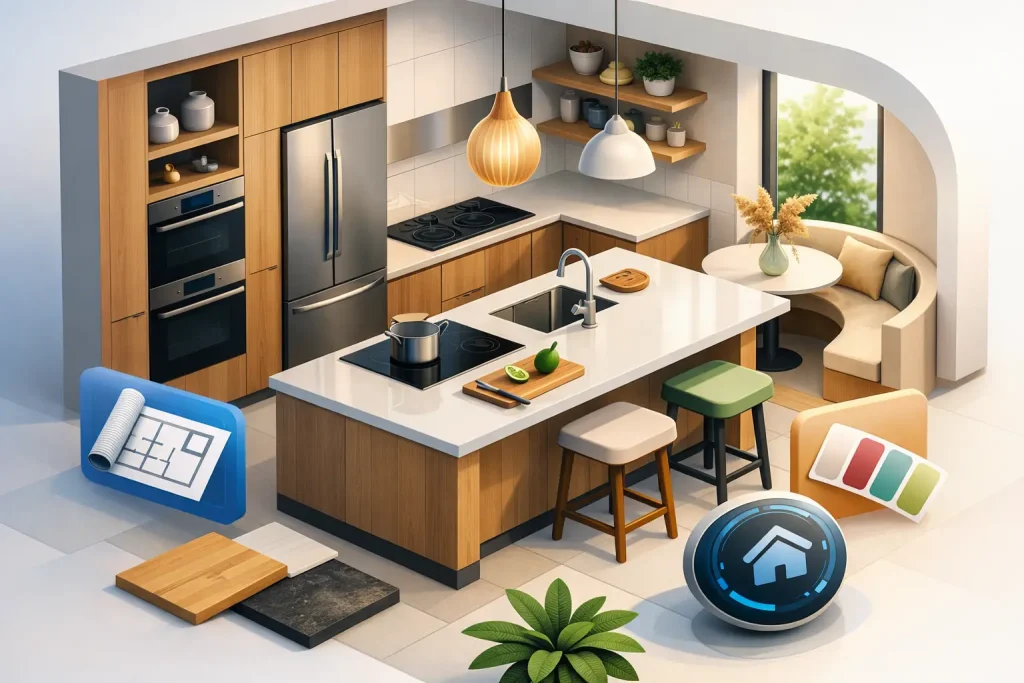
One of the clearest kitchen remodel 2026 trends is the return of wood. Not the heavy orange oak from decades ago, and not overly rustic finishes either. The look is warmer, lighter, and more refined.
White oak, walnut accents, and natural-looking wood grains are showing up on cabinet fronts, open shelving, island bases, and range hoods. They bring warmth into the room without making the space feel dark. For homeowners who found all-white kitchens too sterile, this is a welcome shift.
There is a trade-off, though. Natural wood finishes can show wear differently than painted cabinetry, and the exact tone matters. Go too trendy with the stain color and the kitchen can date itself quickly. The safer move is usually a balanced wood tone paired with timeless materials around it.
Painted cabinets are moving toward softer, earthier colors
White kitchens are not disappearing, but they are no longer the automatic choice. In 2026, cabinet colors are getting softer and more grounded. Warm taupe, muted olive, mushroom, clay, and deep blue-gray are replacing bright whites and stark grays in many remodels.
These colors work well because they add character without overpowering the room. They also tend to hide day-to-day wear better than crisp white paint, which matters in a high-traffic kitchen.
Still, color should be chosen carefully. A shade that looks great in a showroom or on a social post may read completely differently under your home’s lighting. That is one reason a full-room plan matters. Cabinets, counters, backsplash, flooring, and wall color all affect each other.
Storage is becoming more custom and less visible
One reason some kitchens never feel clean is simple: there is nowhere to put anything. That is why hidden storage is one of the strongest trends heading into 2026.
Homeowners want appliance garages, drawer organizers, pull-out pantry systems, trash and recycling built into cabinetry, and deeper storage that actually fits pots, small appliances, and everyday essentials. The goal is not just to add cabinets. It is to make every inch work harder.
This is where remodeling decisions have a real effect on daily life. A kitchen can look beautiful in photos and still be frustrating to use if the layout and storage are wrong. On the other hand, a well-planned remodel can make the space feel calmer before you even add decorative finishes.
For older homes, especially where the original kitchen was not built for modern appliance use, this kind of planning matters even more. Good storage is not a luxury add-on. It is part of what makes the remodel worth the cost.
Slab backsplashes and full-height materials are gaining ground
Backsplashes are becoming simpler and stronger visually. In place of small, busy tile patterns, many 2026 kitchens are using large-format tile or slab material that runs from the countertop up the wall.
This creates a cleaner look and often makes maintenance easier because there are fewer grout lines. It can also make the kitchen feel more high-end without relying on ornate details.
But this is one of those areas where budget matters. Full slab backsplashes can look sharp, especially when matched to the countertop, but they are not the most affordable choice. A well-selected tile can still deliver a strong result. The point is not to chase the expensive option. It is to choose a finish that fits the overall design and holds up to real use.
Lighting is doing more work than ever
Lighting used to be an afterthought in many kitchen remodels. In 2026, it is a core part of the plan. Homeowners want a kitchen that feels bright when needed and warm when they are winding down.
That usually means layering. Recessed lighting handles general illumination, under-cabinet lighting improves prep work, and pendant fixtures add focus over islands or dining areas. In some remodels, toe-kick lighting or cabinet interior lighting adds another level of convenience.
The key is balance. Too many decorative fixtures can make the room feel busy. Too little task lighting can leave dark spots where you actually need to work. Good lighting should make the kitchen easier to use, not just better to photograph.
Islands are becoming more functional, not just bigger
For a while, bigger islands were treated like the answer to everything. That thinking is changing. In 2026, the better question is not how large the island can be. It is what the island needs to do.
Some families want seating for quick meals. Others need drawer storage, microwave placement, or a second prep zone. In certain kitchens, a huge island can actually create traffic problems and make the room feel cramped. In others, expanding the island is absolutely the right move.
This is where experience matters in design and construction. A remodel should respond to the actual room, not force a trend into a layout that does not support it.
Mixed materials are replacing one-note kitchens
Another shift in kitchen remodel 2026 trends is the move away from everything matching exactly. Homeowners are mixing finishes more confidently now. You might see painted perimeter cabinets with a wood island, matte black hardware with warmer metals in lighting, or a stone countertop paired with textured tile.
Done well, this adds depth and gives the kitchen a more custom look. Done poorly, it can feel disconnected fast.
The difference usually comes down to restraint. Two or three coordinated materials can create a strong design. Too many competing finishes can make even a new remodel feel chaotic. The best kitchens still have a clear direction.
What is starting to fade out
Some older trends are losing ground. Cold gray palettes are fading. Ultra-gloss cabinets are less common in family homes. Open shelving is being used more selectively now, since many homeowners learned the hard way that it looks better than it functions. Pot fillers, oversized farmhouse decor, and heavily themed kitchens are also being chosen more carefully.
That does not mean these features are always wrong. It means they should be selected because they fit the homeowner’s needs, not because they were popular online a few years ago.
What homeowners should focus on before they remodel
The smartest way to use 2026 trends is to treat them as tools, not rules. Start with how you use the kitchen now. What annoys you? What slows you down? What always looks cluttered? What feels worn out? Those answers matter more than any single finish choice.
After that, think in layers. First comes layout, then storage, then lighting, then surfaces and style. If the bones of the kitchen are right, the design choices on top have a better chance of lasting.
For homeowners in Staten Island, where homes can range from older layouts to more recently updated spaces, that practical approach matters. A remodel should fit the home, the family, and the long-term value of the property. That is where a full-service contractor like Clean Sweep Contracting brings real value – not just by installing materials, but by helping tie the whole project together from demo to finish work.
The best kitchens in 2026 will not be the ones chasing every new idea. They will be the ones built with care, planned around real life, and finished with enough discipline to still look right years from now. If a trend helps you get there, it is worth considering. If it does not, leave it on the internet.