


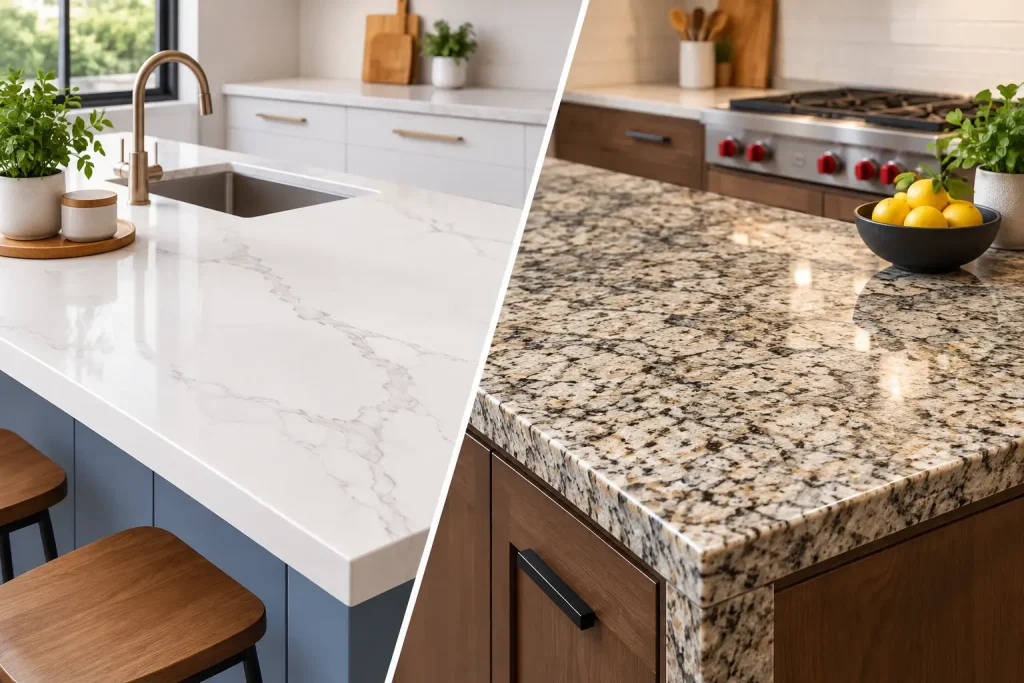
A countertop has to handle more than a few dinner plates. It takes daily cooking, hot pans left too close to the edge, school projects, cleanup after guests, and years of use. When homeowners weigh quartz versus granite, the right answer is rarely about which material is “better” across the board. It comes down to how your household uses the kitchen, the look you want, and how much maintenance you are willing to take on.
Both are strong, attractive choices for a serious kitchen renovation. But they perform differently, age differently, and create very different visual results once cabinets, backsplash, lighting, and flooring are in place.
Quartz Versus Granite: The Main Difference
Granite is a natural stone cut from the earth. Every slab has its own movement, mineral deposits, veining, and color variation. That natural character is the reason many homeowners love it. It can make a kitchen feel warm, substantial, and one of a kind.
Quartz countertops are engineered surfaces. They are made primarily from ground natural quartz combined with resins and pigments. The result is a dense, consistent slab available in a wide range of colors and patterns, from clean white and soft concrete looks to bold marble-style veining.
That difference affects nearly every part of the decision. Granite offers natural variation. Quartz gives you more predictability. Neither is a shortcut material when it is installed properly, but each suits a different type of home and homeowner.
Durability in a Working Kitchen
Granite is extremely hard and handles regular kitchen use well. It resists scratching better than many common countertop materials, and it has strong heat resistance. A hot pot is less likely to cause trouble on granite than on quartz, although using trivets is still the smart move. Sudden temperature changes can damage any stone surface, particularly near seams or cutouts.
Quartz is also highly durable and generally more resistant to staining because it is nonporous. Spilled coffee, oil, wine, or tomato sauce is less likely to soak in if it is wiped up within a reasonable time. That makes it appealing for busy families, rental properties, and homeowners who want a polished kitchen without worrying about sealing the counters.
The trade-off is heat. Quartz resins can discolor, scorch, or crack under excessive direct heat. A pan straight from the stove, a hot baking sheet, or a slow cooker that runs hot in one spot should never sit directly on quartz. In a kitchen where people regularly set down hot cookware without thinking, granite may be the more forgiving surface.
Both materials can chip at an edge if a heavy object hits it hard enough. A quality fabricator and installer can reduce that risk with proper support, careful seam placement, and an edge profile that fits the design. Thin-looking mitered edges, large overhangs, and heavy stone islands need sound construction underneath. This is where countertop selection and renovation work have to be coordinated, not treated as separate jobs.
Maintenance: What Homeowners Actually Deal With
Quartz is the lower-maintenance choice. Routine cleaning usually requires mild soap, water, and a soft cloth. It does not need periodic sealing, and its nonporous surface helps keep everyday messes from becoming permanent stains.
Granite requires more attention, though not as much as some homeowners expect. Most granite countertops should be sealed during installation and resealed periodically based on the specific stone and the product used. Some denser granites can go years between sealing, while more porous slabs may need it sooner. A simple water test can help determine whether the stone is absorbing moisture and needs attention.
Sealing does not make granite indestructible. It helps slow absorption so spills can be cleaned before they leave a mark. Acidic foods, oils, and strongly colored liquids should not sit on any natural stone countertop for long. The good news is that normal care is straightforward when it becomes part of the household routine.
Avoid harsh cleaners, bleach-heavy products, abrasive pads, and strong degreasers on either material unless the manufacturer specifically approves them. A countertop can be expensive, but most damage comes from small habits repeated over time.
Style: Consistency or Natural Character?
This is often where the decision becomes clear. If you want a calm, consistent appearance, quartz is hard to beat. It works especially well in kitchens with modern cabinets, clean lines, and large areas of countertop where a controlled pattern matters. Many quartz designs offer the bright, veined look homeowners associate with marble, without marble’s demanding maintenance.
Granite is for homeowners who want the slab to have a personality of its own. A granite island can become the focal point of a kitchen because no manufactured pattern repeats exactly the same way. Some slabs have quiet movement, while others are dramatic and high contrast. The key is to select the actual slab, not just a small showroom sample.
That advice matters with both materials, but especially with natural stone. A sample can show color, but it cannot show how a large granite slab will move across a ten-foot island. Before finalizing a selection, view the full slab under good lighting and consider how it will look beside cabinet doors, backsplash samples, and flooring.
Cost Is More Than the Price Per Square Foot
It is tempting to compare quartz versus granite by a single number, but installed countertop cost depends on more than the material name. Slab grade, color, thickness, edge detail, sink cutouts, faucet holes, backsplash height, delivery access, demolition, and the number of seams all affect the final price.
Entry-level options in both categories can be reasonably close. Premium quartz designs and rare granite slabs can both move a project into a higher price range. A large waterfall island, complicated layout, or difficult walk-up delivery can add labor regardless of what surface you choose.
The best approach is to make the material decision within the full kitchen budget. Cabinets, electrical work, plumbing, tile, flooring, appliances, and countertop fabrication need to work together. Spending heavily on a dramatic slab while cutting corners on cabinet installation or substrate support is not a good trade.
Kitchen Details That Affect the Right Choice
A few practical details can change the answer quickly. If your kitchen receives intense direct sun through large windows, ask about the specific quartz product’s suitability for UV exposure. Some engineered surfaces can fade or shift in color with prolonged sunlight. Granite generally handles sunlight well, though every slab should still be evaluated for its intended location.
If you are planning an undermount sink, both materials can support it when installed correctly. If you want a large overhang for seating, confirm how much support is needed. Hidden steel, corbels, or brackets may be required depending on the stone thickness and projection.
Also think about seams before choosing a highly patterned surface. Any large countertop may need seams, especially in older Staten Island homes with tight stairs, turns, or limited access. A skilled layout makes seams less noticeable, but dramatic veining requires thoughtful planning so the pattern does not look interrupted.
Which Countertop Is Best for Your Home?
Choose quartz if easy upkeep, stain resistance, and a controlled color pattern are at the top of your list. It is a strong fit for active kitchens where convenience matters and for homeowners who want a clean, consistent look.
Choose granite if you value natural beauty, heat resistance, and a surface with genuine variation. It is a strong choice for homeowners who enjoy the character of real stone and do not mind occasional sealing.
There is no reason to force one material into every kitchen. The best countertop is the one that supports the way you cook, fits the rest of the renovation, and still looks right to you after the showroom sample is gone. Before committing, look at full slabs, ask how the material will be fabricated for your layout, and make sure the installation plan gives the countertop the support it deserves.